Long-term exposure matters
Breathing elevated radon levels over many years increases the risk of lung cancer. Risk depends on both the radon level and how long you are exposed.

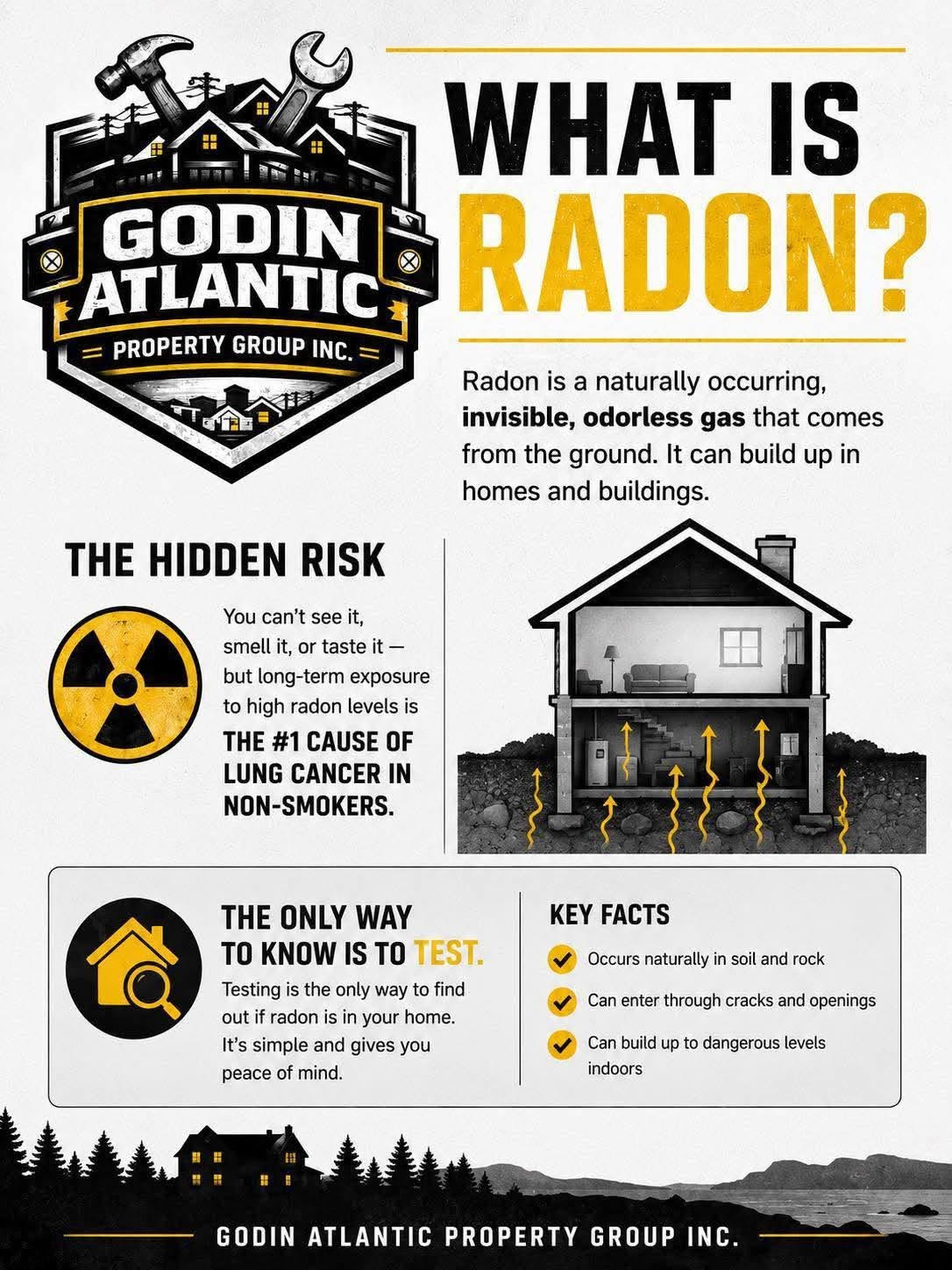
Radon is a naturally occurring radioactive gas you cannot see, smell or taste. It can build up inside any home—and testing is the only way to know your level.
 VIEW FULL-SIZE RADON GUIDE ↗
Long-term average level at which corrective action is recommended.
A long-term measurement is more representative than a quick reading.
NB homes exceeded the guideline in the 2024 Cross-Canada Radon Survey.
Sources: Health Canada and Government of New Brunswick.
Radon is a radioactive gas released naturally as uranium breaks down in soil and rock. Outdoors it disperses into the air. Indoors, it can enter through the foundation and build up over time.
Every home is different. Radon concentrations can vary significantly between neighbouring houses, even when the homes are similar in age or construction.
Radon forms naturally below and around the building.
Gas can enter through cracks, joints, pipe gaps, drains and sumps.
Radon may accumulate in lived-in areas of a home.
Breathing elevated radon levels over many years increases the risk of lung cancer. Risk depends on both the radon level and how long you are exposed.
Radon is the leading cause of lung cancer among people who have never smoked in Canada, according to Health Canada.
Radon exposure and smoking together create a much greater lung-cancer risk than radon exposure alone.
Health Canada's guideline tells you when corrective action is recommended; lowering exposure further can reduce risk.
Place a detector on the lowest level of the home that is regularly lived in—such as a family room, bedroom or office—not necessarily the lowest unfinished space.
Measure for 3 to 12 months, ideally including the fall and winter heating season. Follow the specific detector instructions and avoid moving it.
Use the long-term average from the detector or lab analysis. Hourly and daily readings can rise and fall and should not be treated as the annual result.
Compare your representative long-term result with Health Canada's 200 Bq/m³ guideline. If elevated, explore mitigation options with a certified specialist.
Radon is measured in becquerels per cubic metre (Bq/m³). The Canadian guideline applies to your representative long-term average—not an individual day's reading.
No immediate mitigation is generally recommended based on a representative result. Exposure still carries some risk, so lower is better. Consider retesting after changes to your home.
Health Canada recommends reducing the level within one year, sooner for higher results, with help from a C-NRPP-certified radon mitigation professional.
Learn about radon mitigationIf your test was shorter than three months or missed the heating season, the result may not be representative. A qualified tester can help you interpret it.
The 2024 Cross-Canada Radon Survey found that about one in four New Brunswick homes were above the 200 Bq/m³ guideline.
Ask about testinghomes exceeded the guideline in the 2024 Cross-Canada Radon Survey.
Source: Government of New Brunswick ↗No. Radon has no smell, taste or colour. Neither the age of a home nor a neighbour's test result can reliably predict your home's concentration.
Yes. New and older homes can both have elevated levels. Even homes with a radon system should be tested to confirm the system is doing its job.
Short-term readings can help screen for a potential problem, but radon varies with weather and ventilation. A long-term measurement of at least three months is the recommended basis for decisions.
Fall and winter are preferred because homes are often kept closed up. Health Canada recommends including at least three months of the heating season for a representative test.
Yes. Long-term kits are available for homeowners. You can also ask a qualified radon measurement professional to help you choose a test and understand the results.
Retest after major renovations, changes to ventilation, energy-efficiency upgrades or mitigation work. Health Canada recommends checking homes with active mitigation systems every five years.
Guidance and statistics referenced on this page come from Canadian public health authorities.